Showing posts with label Wikipedia. Show all posts

Social Medipedia

Saturday, October 1, 2011
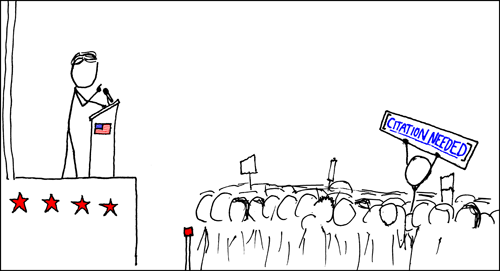

Remember the days when Wikipedia was about as valid of a source as the story told from the guy who knows a guy who knows a guy who has some drug dealer cousin that heard the story from some girl? Even though Wikipedia has become a bit more valid of a source for information, people still have a negative connotation toward citing it as a source for papers.

Social media is now threatening to become the new Wikipedia.

Much like the collective collaboration concept of Wikipedia was great, the immediacy of news on social media is a great concept. It is how we, as a whole, choose to use this tool that will determine how it will be perceived in the future. Posting breaking news on hearsay and questionable information will be the downfall of the reputation for social media as a news outlet.

An article on editorsweblog.org brings up a great question: is tweet first, ask questions later the best policy? Is it so important for people to know right away? When there is the risk of your tweet being incorrect, there is a chance that you will lose credibility. Have enough incorrect tweets, you will not be a valid information source to a large population of the online news readers.

A different article
on editorsweblog.org discusses how several different news companies handle the balance between immediacy versus accuracy. There are ways for these two important news elements to live in harmony, and it would bode well for journalists everywhere is the world would ensure accuracy in their reports. Even something as small as a tweet can cause a massive reaction, and misinformation can end up doing more harm than help.

Do you have any ideas on how to ensure accuracy? How do you make sure your tweets aren't full of false information?

Photo courtesy of creative commons.

Read more...

Wikipedia: 10 Reasons Why its Unrealiable

Tuesday, February 15, 2011


According to a recent article published by Topix.com there are ten main reasons why students shouldn't use Wikipedia as a reliable source for journalism or for academic papers.


10. Always check more than one source for information. Never rely on just one.
Always be sure to look around and get the big picture before assuming things are true. Many scholarly journals and publications have made mistakes and have to correct them later. If a student or journalist relies on one source without checking it, there is a chance that the information could be incorrect even if it appears to be a reliable source.

9. Don't rely on a source like Wikipedia when the author is unknown.
Most people who post information to Wikipedia are un-named and even the editors are not recognized. Always ask yourself who wrote the information and why.

8. Often the contributor with an agenda gets their information out there.
The information posted on Wikipedia is not always the most accurate information. A lot of the time the information that stays published is the information published by the author with an agenda.

7. Contributors with an agenda also coincidently get editing positions as well.
When editors have the power to control the content based on their agenda, that's when the information starts to be inaccurate and opinionated.

6. Some people post wrong information on purpose.
When anyone can post to Wikipedia there is nothing protecting readers from authors who post incorrect information on purpose. Purposely-wrong information can often go unnoticed for months.

5. There is very little diversity among Wikipedia editors. This can reflect in the content left published.
A 2009 study showed that the mass majority of editors were male and are mostly from North America or Europe.

4. Although new information is still being published on Wikipedia everyday, the number of new editors has stopped.

3. The average person is becoming less powerful in the Wikipedia world.
With the contributor numbers down, a small group of editors have most of the control over the large amount of diverse content.

2. Accurate information can get deleted.
When accurate information is published by a reliable source there is still a good chance that it could get deleted. It is all up the the editors and they are the ones who decide what is reliable and what isn't.

1. Wikipedia admits their faults.
Why trust Wikipedia when they tell readers not to rely on their information. The site itself reads, "We do not expect you to trust us." They also go on to say not to trust them as a primary source and that the information on Wikipedia should not be used to make difficult decisions.

Photo Credit: Alexis Brion via Creative commons

Read more...

Journalists not Checking Facts

Wednesday, January 26, 2011

College student Shane Fitzgerald used the popular online encyclopedia Wikipedia in an experiment to show just how dependent journalists are on the internet as their source. Fitzgerald posted a fake quote on Wikipedia supposedly said by Maurice Jarre, a French composer who had recently passed away. After posting the quote, Fitzgerald was surprised to find that not only had various blogs and websites used the quote, but mainstream high- end newspapers as well included it in their versions of the composer’s obituary.
It surprised me that so much of the media depended on such an unreliable source. While I understood how low key bloggers could made the mistake, I would have thought the more upscale and bigger newspapers would not be able to afford making the same one. These papers affect many more people and it should be important for them to get their readers accurate and dependable news. Situations like this may cause them to lose readers and promote the image of their newspaper as being unreliable. While, like in this case, the mistake may not have been very important to many people, I believe a newspapers' reputation is still hurt because in the end it shows their carelessness and laziness when it comes to checking the facts. I think this experiment is a good wake up call to journalists out there in regard to checking facts. It also raises public awareness on being able to identify which source "got it right."

Photo Credit: Britannica via Creative Commons

Read more...

New Platform for Real-Time News

Tuesday, February 23, 2010


Kommons - Trustworthy news in real-time from Vadim Lavrusik on Vimeo.


Cody Brown, a senior at New York University and founder of NYU Local, is at it again. He's come up with a new idea for social media called Kommons.

Brown is still putting together the finished product, but it seems to be similar to Twitter with a twist of Wikipedia.

The idea is that instead of having a few major voices in Twitter giving you news, you can belong to a specific community on Kommons where the news pertains to you. You can also edit and add to certain posts like a Wikipedia page. Instead of using hash tags like Twitter, the @ symbol will be used to create these Wiki-like pages.

Brown plans on making the first community within Kommons for students and faculty at NYU.

A big part Brown's idea is to make sure people aren't anonymous on Kommons like they can be on Twitter. In an article posted by Vadim Lavrusik on his blog, Brown says that "if news reporting in real-time is to improve, genuine identity must be established."

It really seems like this idea may catch on. Just imagine a Twitter-like feed with the editing capabilities of Wikipedia for the Des Moines area. Reporters could even use it to find great stories. My only question is how long until the public gets to try it out?

Read more...

  © Blogger template On The Road by Ourblogtemplates.com 2009

Back to TOP