Showing posts with label censorship. Show all posts

Administrative Censorship

Monday, November 7, 2011
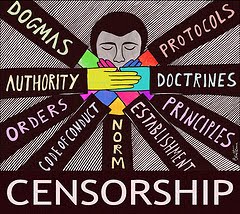

Journalism censorship is being brought to a whole new level. The Seattle School Board is considering to grant a proposal that would allow principles in the district to read high school news papers before they are printed and would be able to censor what they find disruptive to the schools learning environment.


An article in the Seattle Times says that this is the first time the district has tried to put restrictions on what school newspapers can publish. The Board is using an idea that has been suggested by the Washington State School Directors' Association. This group has been recommending this policy since 2001, but many districts have decided not to use it.

The main point of this proposal is to ensure that schools will not get in trouble for derogatory remarks or libel.

The biggest concern is that principles will take too much control over censorship and students will loose the ability to cover certain stories.

The U.S. Supreme Court decided in 1988 through Hazlewood vs. Kuhlmeier that the constitution does not allow freedom of press to high school students.

Even though the Supreme Court has made this decision should school districts like Seattle be able to allow administrators to censor school newspapers?

Photo from: Creative Commons

Read more...

WikiLeaks and Journalistic Sensorship

Tuesday, April 19, 2011

WikiLeaks.

We've all heard of it by now, even if we do not know very much about it or what it actually does.
The main premise of this organization is that it makes classified government documents available to the average person. It gets the information it leaks from anonymous sources through a submissions box, so that no one is punishable for the release of the documents.

Now the main debate with WikiLeaks is whether or not this organization is legal under United States law and the Constitution.


In theory, WikiLeaks is not punishable, for a few different reasons.

Documents released by WikiLeaks typically pertain to the United States, however not all of the documents do.


There is also the matter of whether the release of these documents threatens national security and the functionality of the government.


Another issue is who would actually be punished for the release of this information? Since the sources cannot be identified due to the anonymous submissions, the only name that can be associated with WikiLeaks is Julian Assange who is not an American citizen, but an Austrialian. That brings into the debate international laws and regulations, and whether or not the US would be able to persecute him due to the fact that he is not an American.


I personally believe that WikiLeaks is not something that should be in existence. Sure, we as American citizens deserve to know how the government functions. But there are also things that we do not need to know to allow the government and our lives to run smoothly. If there was no classified information, our government would not be able to function or keep us safe.

Sometimes ignorance really is bliss.


What do you guys think? Post a comment and let me know.


Photo Credit: Creative Commons

Read more...

Is Censorship Realistic?

Tuesday, February 8, 2011

Recently I have been thinking about the fact that not all countries have the same ideals as America when it comes to censorship and free speech. This is evident in the turmoil happening in Egypt recently, with the government attempting to completely shut down the internet to prevent word getting out of the goings on in the country.

This got me thinking about whether or not censorship of journalism is realistic in our society today. With social media sites like Twitter and Facebook, people can update their status or tweet without even needing a computer: they can simply text.

Also, anonymity is another issue that makes censorship nearly impossible. With the ability for people to make Twitter accounts or blogs under pseudonyms or fake names it is nearly impossible for, say, the Egyptian to report or censor all journalists.

There are many people on social media sites that are even encouraging this rebellion.

It seems that these days people are intent on knowing as much information as the possibly can, even sometimes at the expense of laws or respect of the government.


What is your opinion? Do you think that we should be able to have access to all information, even if it goes against the government? Do you think that the journalists in Egypt are right for getting the word out? Do you think censorship still exists, or is it only theory?

Photo Credit: prisonplanet.com via creativecommon.org

Read more...

How Much Do We Need to Know?

Tuesday, April 6, 2010

In 1990, a man dubbed the Gainesville Ripper raped, murdered, and mutilated five college age women in the town of Gainesville, Florida. 17 year old Sonja Larson was one of those women. At some point during the investigation, photos of the crime scenes where the young women were found began to be questioned. Media lawyer Tom Julin, argued for the release of crime scene photos, claiming that in order to maintain the integrity of an open court system, the public has a right to see information such as this.

Wait... wait... this story is over ten years old? Or did I just hear it? The situation sounds familiar.

Recent debate regarding the release of a video tape portraying SeaWorld trainer Dawn Brancheau being attacked by a killer whale, and attempts by a reporter for Hustler magazine to obtain crime scene photos of murder victim Meredith Emerson, have brought older media rights cases to the front line again. They have also raised very important questions for both journalists and media consumers: How much, exactly, does the public need to know?

The terms "sealed documents" and "gag order" have been thrown around much more frequently in the past few years. Due to vast amounts of instantaneous information we have access to, court officials have had to issue these in order to protect both plaintiff and defendant during the proceedings. How is a person going to have a fair trial with photographs floating around showing the criminal acts? Casey Anthony is a perfect example; images showing her partying during the time her two year old child was missing were splashed over the Internet and other sources of news even before her trial began. This was obviously damaging to her defense case, and advantageous for the prosecution. When the trial out of the court room into our living rooms, the information becomes subject to public judgement. Can a person be convicted even before the trial begins?

Ada Larson, mother of murder victim Sonja, described to CNN how devastated she would have been if crime scene photos of her daughter's mutilated body had been flashed over the papers and on the news.

"We did not want our loved ones to be put out there in the scenes where they were found..." she stated regarding the case.

In the Gainesville trial, the judge involved ruled that the media and public could see the 700 crime scene photos, but no copies could be made. This action helped to prevent the photos from being republished time and time again.

Media representatives state that their goal is not to cause harm to the victims or their families, but they also say the public interest regarding these cases has to be respected as well. Rachel Fugate, a media attorney in the state of Florida, states that part of the media's responsibility is to provide verification of facts; this is especially important in situations where there are multiple reports and stories racing through the channels. She does understand, however, that the families of victims need to be respected.

"We are not advocating that the photographs be released or that they be published or broadcast in any manner," she said. "We want the opportunity to inspect."

Inspect, yes. But how far does inspection go? With everyone having cameras on their cell phones, is it truly possible to issue a gag order? A jury sees a crime scene photo and one member snaps a shot with his camera, and sends it to a friend, who sends it to a friend, and so on. Though the member of the jury ultimately may be charged with something, that image is still out there for all to see. Because, in today's world, we have access to everything we could ever want to see at our fingertips if you search hard enough for it.

Note my own experience writing this blog. I typed "Gainesville Ripper" into Google to just get some basic information on the case, and instantly was presented with several links to crime scene photos, and various other crime images, some of which had nothing to do with my search query. Try as we might, we can't protect ourselves from everything. Perhaps the public is served by having media view such images, but beyond that, I personally believe it is a great disservice to everyone involved if the images are released too broadly and splashed across the internet for all to see.

Read more...

China Fires Back at Google

Tuesday, March 23, 2010

Recently Google and China are at a stand off over censorship and human rights activistism.


Goggle first announced that it would consider pulling out of China as of January, saying that it would no longer censor search results of the Chinese government after a set of cyber attacks targeting human rights activists.

"... we stopped censoring our search services--Google Search, Google News, and Google Images-- on Google.cn. Users visiting Google.cn are now being redirected to Google.com.hk, where we are offering uncensored search in simplified Chinese, specifically designed for users in mainland China and delivered via our servers in Hong Kong..."

However, in response to the recent tactic of redirecting Chinese users to its uncensored Hong Kong site the Chinese government began disabling certain searches or blocking the results, according to the New York Times.

Along with the change there has been some backlash for Google. China Mobile is expected to cancel a deal that was supposed to make Google its default mobile search provider.

People believe that Googles anti-censorship movement against China hasn't had much success, at least from the Chinese Internet users perspective.

In response Google said it hopes that the Chinese Government will respect its decision and announced it will be "carefully monitoring access issues," leaving people around the world wondering: what is Google going to do next?

Read more...

Protesting Turkey's YouTube Ban

Tuesday, March 9, 2010

In May of 2008, judges in Turkey banned its citizens from accessing YouTube, under the justification that the Web site failed to obtain authorization to operate within the country. Now, two years later, according to a March 9 article by Clothilde Le Coz featured on MediaShift, newspapers in Turkey are organizing to protest what they view as a suppression of freedoms of speech.


The protest, which began in February, stemmed from two Turkish newspapers, Milliyet Cadde and Haberturk. Although there has been previous protests aimed at repealing the ban, they have been unable to attract widespread attention. The newspapers hope to overcome this precedent by publishing daily the number of days that has passed since the controversial ban.

In addition to the judge's justification that YouTube failed to obtain authorization, Turkish prosecutors and law enforcement officials have the right to "ban access to any website that incites suicide, pedophilia or drug use or that defames Kemal Ataturk (the first president of Turkey)," according to Le Coz. According to Reporters Without Borders, Turkey has wrongly applied this law to ban thousands of Web sites, including ten in 2008.

The ban has numerous political and social implications for Turkey, who currently awaits approval to join the European Union. It remains unclear whether or not the government's censorship of the internet will affect its acceptance to the union, however, many criticize Turkey's position as the 2010 "European Capitol of Culture," arguing that a "cultural" country should promote the democratic use of, rather than censor the Web.

I agree that Turkey's policies regarding YouTube and similar Web sites are not indicative of a country that values culture or freedom of speech. However, what interests me more on this subject, is how strongly journalists are fighting for access to YouTube. Clearly, what was originally seen as a means of entertainment, has become an essential tool for journalists. In my opinion, this is clearly a statement of just how much of a force YouTube, social media, and the democratic use of the Web has become in today's world.

Read more...

Fallout Due to Authoritarian Action

Friday, March 5, 2010

In November of 2009, Kurt Greenbaum, an editor for the St. Louis Post-Dispatch tracked down an anonymous commenter on the newspaper's Web site, who posted a vulgar response dealing with the female anatomy to the "Talk of the Day" feature. Greenbaum then informed the commenter's employer of the vulgar response, who subsequently fired the employee. Lastly, Greenbaum documented this story in his blog and on Twitter.


At the time, Greenbaum could not have expect the type of negative reaction his actions would cause. However, in the four months since, Greenbaum has faced widespread criticism, especially on the Web. Thursday, in an article for the Columbia Journalism Review, writer Justin Peters examined the fallout from the incident and its implications for the future of journalism.

As Peters pointed out, most of the overall anger directed towards Greenbaum stems from question, what led him to believe he had the authority to censor the Web site? This question points to the shifting nature of journalism. No longer, do newspapers have the authority to control readers' attitudes the way they could in the past. In the past, newspapers established authority by sifting through news and deciding what stories to publish. In turn, they set a standard for the appropriateness of certain topics among the paper's community. Readers had little access to other news resources, which forced them to adhere to the standard.

Over the past several years, however, and with the development of the Web and forces such as social media, readers have found new mediums of news consumption. In addition, they have become better equipped to participate in a more democratic format of media. With this new format, those who participate now expect greater power to set standards for conversation, making Greenbaum's actions, in which one person/entity controls and censors the conversation seem to authoritarian. Also, readers and community members have become more empowered to form their own "news organizations," in this case a Web site dedicated to criticizing Greenbaum.

Currently, I'm rather split on this issue. On one hand, I understand Greenbaum's actions and that preserving the integrity of organization's Web site may have necessitated the removal of the comment. However, in the end, I agree that on an ethical level, Greenbaum was wrong to go above the democratic process to censor material he disagreed with. His actions set a precedent that this kind of behavior is acceptable for news organizations and in the future, the public will have to be responsible to hold organizations accountable in similar circumstances.


Read more...

  © Blogger template On The Road by Ourblogtemplates.com 2009

Back to TOP