Showing posts with label student journalism. Show all posts

Student Victory in Court of Appeals

Sunday, November 13, 2011
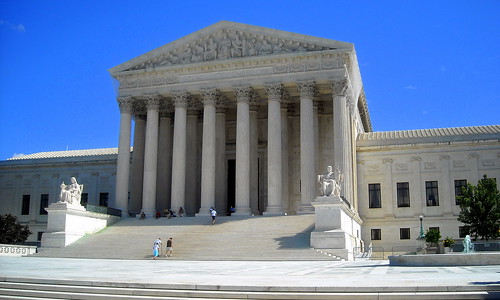
United States Supreme Court

Last Wednesday the Iowa Court of Appeals ruled that school districts can not discipline newspaper advisers for allowing students to run material in student publications that the administration does not approve of. According to the First Amendment Center, the Allamakee School District reprimanded adviser Ben Lange after students at Waukon High School published material in the school paper's April Fool's Day edition that the principal found offensive. Find the case, Lange vs. Diercks and Allamakee School District, here.

The case is being hailed among students and journalism instructors as an acknowledgement of student rights, feared by some to have been taken away in 1988 after the Supreme Court ruled in Hazelwood School District vs. Kulhmeier that administrations had the right to censor student publications.

What does this case really grant students? Admittedly, some of the content that Waukon High School's newspaper the Tribe-une can be considered in poor taste- for instance, the students included a derogatory name for a rival high school and a parody cartoon of a biology teacher caught running a meth lab. But the students involved in the scandal are going to learn a lot about the journalism world.

First, edit your content- just because you have the right to say it, doesn't mean you always should. Making sure you can stand by what you write without holding regrets is a valuable skill in journalism. Basically, if you're going to get in trouble for it, make sure it's good. But also, students do have rights. Critically assessing every situation, both in the classroom and out, is a good way to monitor when your rights are being violated. Students should want to know when boundaries are stepped on and how they can fight back.

Students, stand by your words. And if someone is getting punished for that, then there's a problem.

Photo credit/NCinDC,creativecommons.org

Read more...

Student Journalism Upheld

Wednesday, November 9, 2011


Notch one up for student journalism.


Today, the Iowa Court of Appeals sided with a high school journalism teacher saying that he was unfairly reprimanded for allowing alleged inappropriate articles in the school newspaper.

The court cited the Hazelwood School District v. Kuhlmeier in their decision.


In April of 2008, the Waukon Senior High School Tribe-une distributed an April Fool's edition that consisted of various parody articles. In August of that same year, the principal of Waukon Senior High School issued a reprimand to Ben Lange, the faculty advisor for the newspaper, saying that the newspaper had "numerous inappropriate text, comments, and articles."


The newspaper obviously functioned as a parody, containing articles such as "Meth Lab Found in Biology Lab" and "Cheerleaders on 'Roids." Each page also had the disclaimer: "This issue is a parody created in celebration of All Fools' Day. It contains no factual information."


A few months later, Lange and the newspaper were under fire again after the principal issued another formal reprimand. He stated that the September 30, 2009 issue contained "numerous inappropriate and questionable text, comment, pictures, and articles... people within our school are offended by this edition."


Lange was suspended for two days without pay. In January 2010, Lange took the issue to court.


This case is a good thing for student journalism and journalism in general as First Amendment rights are held up and students' free speech rights are protected.


Read more...

Finishing Strong

Sunday, March 20, 2011

With the nice weather and school year wrapping up, many students at Simpson College are having a rough time staying focused on schoolwork.

But as writers, we know that the show must go on. We have news to deliver and stories to attack. So how exactly can we finish the school year without our minds concentrating on swimming pools and bonfires?

According to Dave Cheong, there are 11 techniques you can use to help stay focused on anything you are asked to tackle. Below, I have listed just a few tips that can be used very efficiently while working on a story.

The first tip is having well defined goals in your work. Whether it's writing them down in a book or simply remembering them, knowing what you want to accomplish as a writer can be made easier by setting guidelines for yourself.

Another suggestion made is breaking things into smaller chunks. As journalists, we have deadlines that we are required to meet. However, taking small breaks helps enable a clear mind and ability to perform at your best.

The third tip is enlisting family and friends for help. Whether it's tell them your goals or seeking their opinion on a story, these are the people in your life that can honestly tell you what kind of progress you are making.

One last tip that can be helpful to a writer is blocking out some time. Whether it's waking up earlier or simply setting aside a certain part of the day for a given task, this helps approach a story motivated and more focused. Afterward, you may find that you have time to go to get some ice cream or go run around in the nice weather.

Just because it's nice out, doesn't mean the news stops for us to have fun in the sun. As journalists, we must prioritize our tasks.

A personal solution I have for my BNR classmates is to go write a story outside in Buxton Park. By doing this, you can enjoy the benefits of good weather and a good story all at once.

With finals approaching us quicker than we think, it is a good time for Simpson students to stop and make a plan about finishing the year off strong.

Photo Credit: Learning Fundamentals via Creative Commons.

Follow morganfleener on Twitter

Read more...

Journalist: A Risky Job

Tuesday, February 1, 2011


Since Dec. 29, 2009, two French journalists are held hostage in Afghanistan. It will be 400 days this Wednesday february 2nd. that Herve Ghesguiere and Stephane Taponier, great reporters for the French public channel FRANCE 3 were kidnapped.
In December, a video sent by the captors showed the two captives alive and calm but emaciated.
While the French governement has at various times issued statements insisting that negotiations for the release of the two mens were progressing, they remain captive and their families have spoken to the media for the first time about their frustrations in December.
"When the foreign minister Michelle Alliot-Marie speaks of a 'short time', we say to ourselves it's imminent." Taponier's father gerard told Agence France Presse. "And then Christmas is already gone...we are still hoping for good news but it gets you down."
Families and colleagues of the two journalists have called for a rally this Wednesday at 2 p.m (local time) in front of the National Assembly in Paris. This rally will only be a moment of contemplation. It will not have any speeches, nor speaking but only a simple moment of communion to support the two journalists-hostages.
Journalist is not an easy job. Sometimes while covering a story you face the risk of being arrested like some journalists in Egypt, or even killed like many journalists in China, russia or Irak.
The freedom of speech and information is, unfortunatelly, not an universal right. Some countries, all over the world, are still controling what is on the news and do not hesitate to use the force to persuade reporters not to critizise governments or not to deal with governments' actions in some regions of the world.
Photo credit: Agence France Presse (AFP) via Creativecommons.org.

Read more...

Make an Impression in your Interview

Tuesday, December 7, 2010

Journalism and communications majors are increasing becoming a popular academic choice for undergraduate students in college campuses across the nation. According to The Princeton Review, communications studies sits at number eight out of the top 10 college majors with the best opportunities to succeed. That being said, a number of young journalists seek to enter the professional world of journalism fresh out of college, ready to embark on their career-adventure.

With the job market competition rising in nearly every field, student will have to work extra hard to stand out to potential employers.

In addition to having an impressive resume and an online/social media awareness and presence, students need to posses a variety of skills in video, broadcasting/sound, strong writing, photography and design.

But most importantly, a student looking for a job in journalism needs to have the interpersonal qualities and personality that will help them stand out in an interview.

Sometimes, employers get blessed with having a multitude of qualified candidates to choose from for an opening position. If that's the case, it may only take a minor infraction to get dismissed from a job opportunity. It may come down to likeability or how well you answer questions...even how you dress could make or break landing that first job in journalism.

So here's five simple things to keep in mind going in to your first interview as a student journalist:

1. Dress for success - It may sound corny, but it's true. Dress like you want to be taken seriously. No jeans. No tennis shoes. If you want to be a professional, you've got to start acting like one. It shows confidence, and that's an attractive quality in a young candidate.

2. Do your homework - Know the company you are applying to work for. It shows your potential employers that you're on top of your game and that you care about this job offer. Find out as much as you can, through a website or word of mouth, and ask questions about anything you don't know.

3. Ask questions - People in the journalism field are by nature, curious. If you ask questions, it shows that you're someone who wants the job, and ultimately is the job. Journalists focus their lives on finding the story in everything, so why not start in your first interview?

4. Show them what you have to offer - As mentioned previously, journalists need to have a pretty large skill set in their tool box in order to cut it in the profession. But if you're really talented in one area/medium, prove it. Put together a strong portfolio of your work to highlight your talents and make that the emphasis in your interview. You never know what employers are looking for, and you might have something unique to offer over the other candidates.

5. Bring the right attitude - There's a fine line between confidence and cocky. Don't assume you've got an interview in the bag. Confidence is a large part of the interview, but so is likeability and positive personality traits. Those are things that are going to make people want to work with you, which will ultimately enhance your credibility and reputation as a journalist.


A strong skill set and sense of awareness can compliment a good resume and work history...but nothing can make or break a job opportunity like an interview. With these ideas in mind, go into your next interview for a job in journalism, or any field, knowing that you did everything that you could to present yourself as the best possible candidate.

Read more...

Journalism Exchange Program at U of I

Tuesday, November 16, 2010

In the liberal arts college setting, a shift has been made to allow for students to get a more hands on education in the field(s) of their choice. Whether it be in a student teaching or mentoring program, or applied practicums in students medias, different majors stress the importance of getting 'real world' experience to help better prepare them for a professional career.


One state school has developed a program that focuses on giving its journalism students every possible opportunity to excel in a hands on field-experience program.

The University of Iowa's School of Journalism and Mass Communication has implemented a program called North American Environmental Journalism Project (VITAL), which is funded by the US Department of Education, to help give their journalism students a 'leg-up' on other student journalists.

This program is a negotiated exchange consortium with seven different schools from the United States, Canada and Mexico. The program allows for students to study, report on, and develop an awareness for environmental journalism, with special emphasis on water resource and water sustainability issues. The program also hopes to allow for students to gain a sense of cultural awareness and still enhancing their journalistic skills.

Members of the student exchange program focus on projects in specific areas of concern in their given geographical region. The students research these issues and then post forums in a website to share information and publish their work. Some may also work with broadcast news/production and shoot, edit, and stream video on news and campus TV stations.

With exchanges between schools on the North American continent, the goal is to promote awareness for issues going on close to home and to form a sense of community among the students involved.

The University of Iowa has chosen this program to focus on environmental journalism, but students do not have to a background in biology or environmental issues in order to participate.

This program, however, is not unique to its kind. Other small liberal arts institutions also encourage study abroad courses during the semester, or for partial semesters. But this program in particular focuses on cultivating students' abilities in a specific area to give them hands on experience for their intended profession. Getting real, hands on training makes students applying for their first jobs in a given field more attractive candidates to employers...which is the goal of any school wishing to educate students eager to enter the workforce.

Check out the YouTube clip below for more commentary about this program:

Read more...

  © Blogger template On The Road by Ourblogtemplates.com 2009

Back to TOP
