Showing posts with label Protests. Show all posts

Rage Against the Media

Tuesday, September 20, 2011
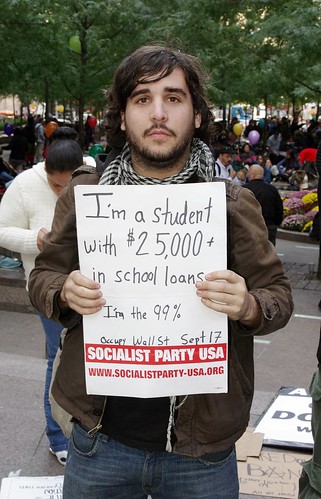
Day 3 Occupy Wall Street 2011 Shankbone 7
Photo courtesy of CreativeCommons.org

On September 17th, all was normal with Twitter. However, if you chose to glance down at trending topics, there were a couple of interesting choices:
#occupywallstreet
#sept17
#USdayofrage

If you were intrigued enough to click on one of these hashtags, the content might have surprised you. For it appeared our nation was in the middle of a giant, unexpected economic protest on Wall Street. The hacktivist group Anonymous used some of its many Twitter accounts to help organize the event, and stood among the crowd during peaceful demonstrations against 'coporate pigs' and the American government.

If you were watching the mainstream American news, you never would have heard any of it. As the day went on, Twitter users began complaining of a major media blackout against what they claimed civilians would deem to be news. And it seems to be true: the first major media company to release an article over the event was Al Jeezera English, a foreign media outlet (read the article here). In fact, while Al Jeezera released their article the same day as the popular revolution begun, it took American outlets at least a full day before they began to release any kind of coverage (see Business Week's coverage here). It was too long for the protesters, one of whom tweeted "This whole lack of news coverage thing for #occupywallstreet is kind of disturbing. Yet the asinine Glen Beck rally got all that press?"

Why did it take the American media so long to respond to a major protest on one of our country's most famous streets? For weeks, journalists have been covering foreign protests with a lot of effort and no small amount of dedication, yet the biggest news of Saturday was left to the foreign media and protesters to break themselves. There is speculation that major media corporations dragged their feet on purpose to cover it, because after all- the public was protesting specifically against corporations. Were the major news networks purposefully avoiding the subject to save their own dignity?

If journalists are going to continue referring to themselves as our nation's 'watchdog', then they need to be watching their own business moves. When you are a journalist, you don't do what's best for the corporation. You're doing what's best for your nation's civilians, and sometimes, you need to swallow your pride.

Read more...

Lara Logan Assulted in Egypt

Wednesday, February 16, 2011


Logan was accused of being an Israeli spy and told to leave Egypt earlier this month. After being detained she went back to the U.S.

Shortly after her return to the U.S. she went back to Cairo before Mubarak fled his office.

Logan has made her name as a war reporter for Britain's GMTV in 2001 at the beginning of the Afghanistan war. Later she reported on the war in Iraq. In 2002 Logan joined CBS News.

There are at leased 140 injured or killed reporters while covering the Egypt protests since Jan. 30 according to the committee to Protect Foreign Journalists.

Photo Credit: Creative Commons


Read more...

The Role of Media in Protests in Africa.

Tuesday, February 15, 2011


Since January, media do not speak nearly as protests in Africa. Tunisia was the first country hit by revolts. Since it affects many African countries.

Did media play an important role in the spread of the idea of freedom across a continent largely sidelined by dictatorship and persecution?

The primary role of media is to deliver the information and also to reveal the truth to the world about criminal actions of government, as was the case in Egypt with Hosni Mubarak.

Indeed, they were so effective that countries around Egypt and Tunisia, decided to start revolutions after seeing the results in Egypt. Now Algeria, Yemen and Bahrein are protesting against their government.

I believe the internet plays a major role spreading the information, especially through social media like Twitter and Facebook.

Nowadays, media are playing an important role giving the information quickly and accurately. The internet stays the main source of information for many people all around the world.


Photo credits: flickr.com via creativecommons.org


Read more...

Speak and Tweet in Egypt

Monday, January 31, 2011

President Hosni Mubarak has had his hands full in Egypt since last Tuesday. Citizens have been outraged and want to kick Mubarak out of power. Many Egyptian protesters are upset about not receiving many things from the government, including their freedom and internet.


Last week, the Egyptian government put a blackout on all internet usage. Government officials felt like this would be a beneficial way to block the outside world from seeing what's going on and from protesters organizing groups via Internet. With the websites blocked, journalists were in a world of hurt, as they were unable to communicate, surf, or report through Google, Facebook, Twitter, or BlackBerry Services.

However, Google and SayNow have provided hope for many reporters to share news once again. They developed a way for people currently in the Egypt area to tweet via phone on Speak-To-Tweet. Users have been given the option of three numbers to leave a voice mail to, which will be turned into a tweet under the hashtag of #Egypt or #speak2tweet.

Imagine being an Egyptian writer unable to report some of the biggest protests in your country. Journalists want to recreate stories so viewers can connect to current events. Many reporters in Egypt currently feel relieved to be provided with a way to do their job.

As journalists, this is a good time for Egyptian reporters to practice reporting news by observation instead of relying on the internet for news. Egyptian queen Cleopatra once said, "I will not be triumphed over." Many reporters should take this advice and realize there is always a way to get the job done and report globally what is going on.

Photo Credit: Nima Maleki

Read more...

Protests Escalate in Egypt, Journalists Arrested

Wednesday, January 26, 2011

Egypt proves to be a dangerous place for journalists once again with the latest round of protests against the government of President Hosni Mubarak. Eight Egyptian journalists were arrested last week after participating in an anti-government protest, bringing the grand total of arrests up to 860.


Egyptian security forces have been deployed to control the rioting crowds through the use of tear gas. So far, five people have been killed. The Egyptian government has also been restricting access to websites such as Facebook and Twitter in an attempt to cripple the protest movement.

The European Union has publicly called on Egypt to respect their citizens' rights to protest, but the response from the Egyptian government has been disappointing. "No provocative movements or protest gatherings or organization of marches or demonstrations will be allowed," MENA reports the ministry as saying. "Immediate legal procedures will be taken and participants will be handed over to investigating authorities."

Protesters are angry about soaring food prices, a lack of jobs and an oppressive government, among other complaints. Despite the strong negative response from Mubarak's ministry and the danger from Egyptian security forces, protesters continue to take to the streets in thousands.


Photo Credit: Creative Commons, James Buck.

Read more...

The Digital Age

Tuesday, March 30, 2010

Almost everywhere we go at any time you might find someone using a social networking site. Either in a computer lab or on their phone social networking is huge. What happens then when a government shuts down media and no longer allows news correspondence into the country to cover protests and violence? Well, we turn to social networking as a way to gather and disseminate information.


In Tehran, where violence and protests have been going on since June, local citizens have been using networks such as twitter and facebook in order to post live video and other information onto the web. The local government in Tehran has closed down all access from outside correspondence and have even kept local media personel contained in their news stations.
When there is a big clash between amatuer journalists and professional journalists this is a big case for why amateur journalism can be a good thing. How else would the world get video information? They wouldn't because they aren't locals with video cameras posting videos on the internet.
News nowadays should be an equal give and take between local non news affiliated citizens and news reporters. Locals are probobly more likely to open up to someone they know who has a video camera than a news reporter who wants to interview them. Also, by locals using social networking sites to display information there is non to little editing taking place from time of creation until posting. By not going through traditional means to display the news there is also not a bias as to what is shown and what wouldn't be shown. As we know reporting is supposed to show an unbiased side of an event, however we know that some news stations do edit their media for content and to maintain time limits. When locals film things such as what is happening in Tehran we see hard unedited footage of the life as a person living in these troubled areas.

Read more...

  © Blogger template On The Road by Ourblogtemplates.com 2009

Back to TOP